Exam-week study schedule you can actually follow

An exam-week study schedule works when it gives each day before the test a job, instead of just saying "study more." Start four to six days out by listing topics and ranking your weak spots, use the middle days to explain the material out loud and take a timed practice test, and keep the day before for reviewing what you missed, with no new chapters. Plan the week around types of task (organize, rehearse, practice, rest) instead of endless rereading.
Why "I'll study all week" fails
Open calendars fill up with meetings, labs, work shifts, and group chats. Without named study blocks and a ranked topic list, exam week turns into late-night rereading of the easiest chapter. University learning centers recommend the opposite: plan the week, put weak topics first, explain things out loud, and simulate the test (Stanford CTL, Week Prior Test Prep Strategy).
A perfect color-coded grid is optional. What you need is (1) a topic list ranked by weakness, (2) one practice test under real conditions, and (3) a protected night of sleep before the exam.
A seven-day exam planner
Copy this for each exam. Work backward from exam day.
Six to four days out: plan and organize
- List every topic or chapter that could come up.
- Highlight the ones you understand least.
- Put study blocks on the calendar for the rest of the week (at the same times, if you can).
- Gather notes, slides, and past quizzes into one folder.
Task types for these days: organize, outline, and make a one-page "cheat sheet" of formulas or definitions (even if you can't bring it in).
Three days out: prioritize and explain
- Study weak topics first.
- Explain each weak topic out loud to a wall, a roommate, or a recording. Feeling familiar with something isn't the same as understanding it (Stanford CTL).
- Use mnemonics or a rough concept map only where they help you recall, not as decoration.
Two days out: rehearse under exam conditions
- Take a practice test with the real exam's time limit and tool rules, when you can.
- Sit somewhere similar, like the library or a quiet room, with your phone in another room.
- Mark every miss, and don't stop to restudy in the middle of the test.
The day before: review misses only
- Redo only the problems or topics you missed.
- Take any remaining questions to a classmate, TA, or professor.
- Pack what you need for exam day, and set two alarms.
- Stop early enough to go to bed at your normal time.
Exam day
- Warm up with one easy problem you already know, not a new challenge (Stanford CTL).
- Bring water and whatever the instructor allows.
- Two slow breaths before you start is plenty. This isn't the morning to invent a new ritual.
Task-type menu (pick, don't invent)
If your plan says only "reread notes," switch half the blocks to encoding or rehearsing.
Daily study card (25 or 50 minutes)
Use it between classes or in the evening:
Exam: ________   Days until exam: __
Block length: 25 / 50 minutes
Weak topic today:
Task type: organize / encode / rehearse / patch
Done when:
Next block starts:
Two focused blocks beat five distracted hours.
Follow each one with a short break (5 or 10 minutes), and write down the next block's topic before you leave the desk.
Build the week around real life
- Work or labs: Put the practice test on the evening with the fewest interruptions.
- Two exams in one week: Keep separate topic lists. Don't mix both subjects in one hour; finish one card, then start the other.
- Group study: Use it for explaining topics to each other and working practice questions, and rewrite your notes on your own time.
- ADHD or trouble focusing: Choose shorter blocks with a visible next step. Body doubling (studying on a call with someone else who is working) helps some students, and a later guide covers it.
Worked example: biology midterm on Thursday
- Saturday (5 days out): Lists 12 chapters. Highlights membranes, respiration, and genetics as weak. Blocks out 7:00 to 8:30 every evening from Sunday to Wednesday.
- Sunday (4 days out): Makes a one-pager of the pathways and puts the lab notes in one folder.
- Monday (3 days out): Explains respiration into a voice memo and redraws the membrane diagram from memory.
- Tuesday (2 days out): Takes a 50-minute practice exam from the study packet, phone in another room. Misses 8 of 40.
- Wednesday (the day before): Redoes the eight misses, emails the TA one question, packs a calculator and ID, and is in bed by 11.
- Thursday: Does one easy warm-up problem in the hallway, then sits the exam.
No all-nighter, and no new chapter on Wednesday night.
Do it in Unmiss
Run a study session with the breaks built in
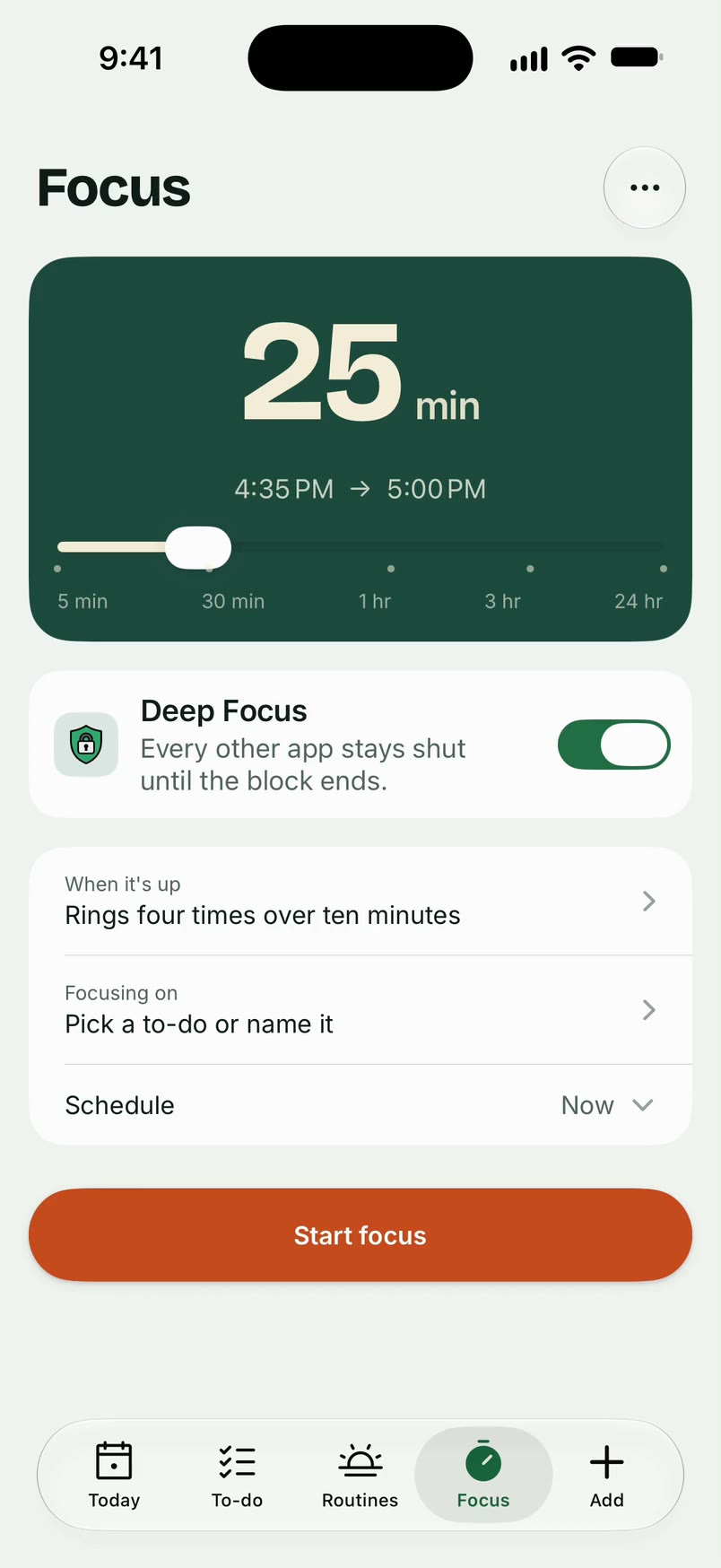
Unmiss has a ready-made Study session routine with the breaks built in: read, break, notes, break, review, each step timed. Rename the steps to match the day's card and tap Start. Use Focus when you want the apps you pick kept shut for a 25- or 50-minute block. The planner above works on paper too.

Questions
How many days before an exam should I start?
Four to six days of planned work is a sensible default for a typical midterm. A big cumulative final may need longer: list the topics two weeks out, then run this week-before plan.
Is rereading enough?
Usually not. Add explaining out loud and at least one timed practice test under exam rules.
What if I only have three days?
On the first day, make the topic list and find your weak spots. On the second, take a practice test. On the third, patch your misses and get some sleep. Skip new reading.
Should I pull an all-nighter?
No. The day-before plan above assumes a normal bedtime, so protect it.
Sources
- Stanford Center for Teaching and Learning, Week Prior Test Prep Strategy
More guides

Body doubling for ADHD: how to run a session (with a script)
What body doubling is, how to run a 45-minute session, a partner script, and how light accountability differs from sharing private steps.
How to stop doomscrolling (at night and in the morning)
Stop doomscrolling at night and in the morning: a phone-setup checklist, things to do instead, and short scripts for ADHD, parents, students and work.